
Photographic Visions – Autumn 2026
A curated international photography exhibition
October 17 – November 10, 2026, Barcelona
 |  |
|---|---|
 |  |
 |  |
 |  |
 |  |
 |  |
 |  |
 |  |
 |  |
 |  |
 |  |
 |  |
 |  |
 |  |
 |  |
 |  |
 |  |
 |  |
 |  |
 |  |
 |  |
Click on the thumbnail to view the image. Click on the image for a larger view and information.
"Photographic Visions" is a biannual exhibition at PH21 Gallery showcasing mini-series of works from selected artists who submitted their portfolios for our solo exhibition competition. Our goal is to celebrate the work of photographers with progressive and visionary portfolios, pushing the boundaries of photography in the 21st century.
"Photographic Visions – Autumn 2026" features three images presented in mini-series from the selected photographers.
To learn more about the photographers, click on their names to visit their respective websites.
Exhibiting artists:
My photographs are staged and constructed as if they were stills taken from a movie, book or play that does not actually exist. My concepts usually start in my head from dreams or memories. I find it interesting how the recollection of memories over time can become highly stylized in a way that fresh memories seem different. I enjoy collaborating with the people I photograph and I let concepts evolve as I only see my ideas as a starting point.
Elsa Faudé
Elsa Faudé’s photographic wandering is a journey through dreams, memory and identity, engaging in a dialogue between intimacy and universality. Through mixed media, she transforms photography into a critical tool for questioning mechanisms of resistance and emancipation. Her cinematographic visions, poised between dream and surreality, explore alternative processes and countercultural representations.
1. Like Sands. 2026
Tokyo, Japan is a photographer's canvas. The architecture, groundscapes and grass with lighting invite the entry of a subject to complete the composition. Here the pattern and materials of the groundscape become a place of serenity amidst a hurrying busy city. The color scheme and the geometry give the feeling of sands on a beach.
2. On Stairs. 2026
Geometry in Tokyo is an interesting playground. In the bright midday a passerby adds depth and shadow to the scene. It is always a decisive moment, which is fleeting, yet held in time by a photograph.
3. Diagonal Path. 2026
Tokyo is a city with geometric wall patterns, floor patterns that act as a backdrop for incoming or outgoing pedestrians. When the right subject positions in the right place it creates a moment. The black and white patterns on the ground are fascinating. Many people in Tokyo carry umbrellas rain or shine. Umbrellas create a vibe and work as a life prop in the right place at the right time.
Concept. No concept — a game. A game — no rules. No rules — ukrop. ukrop (rus.) — dill, endro
Tools: object, light, shadow, camera, magnification, manipulation.
It all starts with my riches — dry leaves, sticks, petals. I choose the material and build the arrangement, so the image is mine, but I never know it in advance: one thing when I pick up a branch, another through the camera, a third when I work on it afterwards. Shift one element and there it is — a whole different image, and every time it gets me. What has lived out its life gets a new one. While the planet lives, the number of combinations is endless — one can work forever.
Water is constantly changing, turning reflections of the world around us into abstract forms. In these images, light, colour and movement transform reflections into fleeting forms, creating depth and shifting between the familiar and the abstract. What we see existed only for a moment before the water reshaped it into something new. The surface becomes a space in between – between reflection and reality, recognition and imagination. In the encounter with the viewer, the image may reveal something I never intended or imagined.
Fortunately for me, I have always been a vivid dreamer and I frequently can recall the contents of my dreams. The three images included in this exhibition are culled from my ever-growing project titled Dreams Reconstructed, which photographically reconstructs key imagery — both positive and negative in nature — contained in my own recalled dreams as documented upon awakening in my personal dream journal. As can be seen in the cumulative offerings of this collection, my overall approach to photography and related forms of artistic production results from the combined influences of Cubism, Expressionism, Fauvism, Impressionism, and Surrealism, all of which affect how I see the world around me and then proceed to document it. This process involves important decisions regarding matters of abstraction, distortion, fragmentation, and emotional affect as well as whether to capture a subject realistically or instead quite innovatively.
Subtle moments in which reality begins to shift are at the heart of my work. My photographs open a space between reality and imagination, where perception, memory and emotion quietly interwine. Working predominantly with a medium format camera, I embrace a slow and deliberate rhythm. It allows me to immerse myself fully in a meditating act of seeing. Light, structure, colour and movement become the essence of the image. I seek to leave space for individual perception and interpretation, inviting the viewer to linger and find their own way into the image.
I am a Japan-based artist creating photographic diptychs using English words and phrases found on clothing and personal items on the streets of Tokyo. By pairing these fragments of language, I create unexpected conversations and new meanings. My bilingual experience and the way English is used in Japan influence my practice. I am inspired by the unexpected and often overlooked moments I encounter in everyday life, which make me stop, look, and wonder. In a fast-paced city, I want to make the familiar strange and bring the unnoticed into focus, inviting the viewer to pause, look twice, and see things in a new way.
Lou Liska is a gender-queer performer, artist, and human ecologist based in Guntramsdorf, near Vienna, Austria.
Coming to art without formal training, Lou’s practice is shaped by a working-class background and a sustained engagement with structures of power. Social, economic, and political hierarchies inform an ongoing investigation into how identity, agency, and self-empowerment are negotiated within, and against, these systems. A non-binary perspective functions as both position and method, resisting fixed categories in favor of fluid, relational modes of making.
‘On Masculinity’ is a series of lens-based, staged images using dolls and props to explore the aggressive and sexual drives men struggle to reconcile. The series was made using a reflective silver Mylar surface covered with a thin white semi opaque sheet of packing material as a background. The one consistent element used throughout the series is a neutral gray scale male doll. Additional props are enlisted throughout the series as well. All images were shot in natural light from an overhead skylight. After editing and in post-production, I reverse the image and manipulate the blue/purple/gray tonal values I felt best conveyed the mood I was going for.
Geometry of Shore examines the graphic rhythms of natural and human-made objects along the coast. The series explores what truly defines a shoreline - a space in constant flux, perpetually reshaped by water, wind, and human presence.
Photographed over three years mostly along a single stretch of the Cyprus coast, these high-contrast black-and-white images were made during early morning hours when strong, low-angled light carves out bold forms in relative solitude. Though the geography remains fixed, shifting light and changing seasons continuously unearth new structures—where hard shadows, tide-swept debris, and weathered terrain meet.
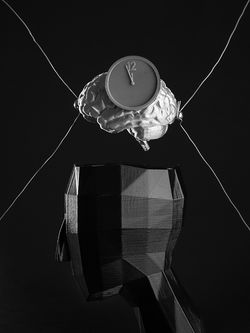
We live in a very nihilistic society controlled by an administration bent on damaging the core structures that define American existence. This body of work has a subtle call to action using political themes and the never-ending ticking clock. Wasting time, or running out of time to act, the messages invoke a fear of the constant flux and loss of American rights. With hints of irony or wry humor, some pieces lean farther into the supernatural, yet still hold the same themes and questions regarding the current state of the world. All images are crafted in black and white photography within a studio setting. The scenes and compositions created use a mix of 3D models and small-scale items to simulate the ongoing struggles of American society.
Nebō began as a record of things that block, close, or contain, and it has become a study of what waits on the other side of them. Vantage, Threshold, and Trajectory No. 1 each hold a structure at the instant it stops being neutral: a stair that argues with the building it climbs, a gate that decides who passes, a vista that only exists from one fixed and narrow point. I photograph these conditions with the patience of someone cataloguing evidence, because the city confesses more in its thresholds than in its faces. The work doesn't resolve the tension between confinement and access; rather, it holds both at once, the way the cities themselves do. What's left is less a document of place than a record of searching and finding, in concrete and steel, a strange permanence.
Marlene Tukur Scheurlen
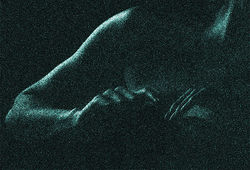
Elsewhere, here explores the space between performance and reality, where the distinction between what is staged and what is lived begins to dissolve. Through film photography, I look for moments that feel both observed and constructed—gestures, shadows, bodies, spaces, and fragments that suggest a scene without revealing whether it is real or performed. The work is drawn to the theatricality that exists within ordinary life, and to the quiet ways we inhabit, rehearse, and perform versions of ourselves. Rather than seeking to document a fixed reality, these images linger in the uncertainty between presence and illusion, intimacy and observation, memory and invention. Elsewhere, here lingers at the curtain between reality and performance, where it becomes difficult to tell which side we are standing on.

