
Leena Holmström: On the Rock’s Skin
October 17 – November 10, 2026, Barcelona
 |  |
|---|---|
 |  |
 |  |
 |  |
 |  |
 |  |
 |  |
 |  |
 |  |
 |  |
Click on the thumbnail to view the image. Click on the image for a larger view and information.
Artist statement
Leena Holmström: On the Rock’s Skin
On the Rock’s Skin explores the boundary between the visible and the invisible through photography, perception, memory, and imagination. At the heart of the series is the question: Why do I photograph what I photograph? What is it in reality that catches my eye and makes me pause at a particular place, light, surface, or moment?
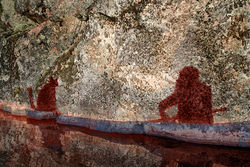
A few years ago, I made a series of rowing and photography trips to the foot of the ancient rock face of Ukonnokka. (photos 1-15) In the sunlight, my own shadow and that of the boat were momentarily cast onto the lichen-covered rock. My experiences there led me to think of the landscape as layered with time and memory. Although there were no visible rock paintings on the surface, I began to imagine traces and events of ancient people. I could almost hear the beating of shamans’ drums and the rhythm of their dance. The place began to feel both real and imagined — a landscape where the present and an imagined past could meet.
The photograph preserved the fleeting moment of the shadows cast upon the rock. Years later, I returned to these images and began working with the shadows already present in them. Through intense colours, layering, and multiple exposures, their forms gradually began to unfold into figures and events that seemed to have been present in the images before I knew how to see them. The process resembled an archaeological excavation: by building up and peeling back the image layer by layer, something began to emerge whose possibility had already been present in the original perception.
Photography thus became a means through which the original perception could continue to unfold and change over time. It was no longer simply a record of the visible landscape, but opened a connection to an inner and imagined landscape as well. The rock became like a canvas on which the play of shadow figures was inscribed. The emotions and stories emerging from the works were both fictional and real.
At Värikallio in Hossa (photos 16-20), I encounter traces of a different kind. Images made by humans have survived on the rock face for thousands of years, while the experiences of their makers and the original meanings of the images remain largely invisible to us. Alongside the rock paintings, the rock’s own colours, forms, cracks, patterns, and reflections invite the eye to search and imagine. At times, a figure is clearly visible; at others, the eye begins to search for one on a surface where there may be nothing certain to find.
Bringing Ukonnokka and Värikallio into dialogue brings together different forms of presence and trace. At Ukonnokka, the fleeting trace of my own presence, created by light, disappears from the surface of the rock but remains in the photograph, later becoming the starting point for a new image. At Värikallio, an image deliberately left by a human hand has endured for thousands of years, while the world that once surrounded it has disappeared.
Within the series, the photograph is simultaneously a trace of the world and a trace of the gaze. It records something that was actually present before the camera, but it also contains the photographer’s act of selection: why this particular moment, surface, or form was seen and photographed. Perception is not neutral. It is intertwined with memories, experiences, imagination, and unconscious associations. When I return to a photograph years later, perception itself can continue to unfold and change.
On the Rock’s Skin moves between the real and the imagined, the fleeting and the enduring, the present and the past. It asks: At what point does seeing become imagining, and a shadow become a figure? What does an image reveal about the world — and what does it reveal about the way we look at it? Can a landscape awaken in us something like a memory of something we have never experienced ourselves?
At Ukonnokka, the fleeting becomes lasting through photography. At Värikallio, an enduring trace leads towards a past we can no longer see. In both, a visible trace opens onto the invisible.
Biography
I am a photographic artist based in Oulu, Northern Finland. I pursued my artistic education later in life, graduating with a Bachelor in Fine Arts from Lapland University of Applied Sciences in 2016 and a Master of Arts from the University of Lapland in 2018. I also hold a Bachelor’s degree in conservation and restoration, completed in 2000.
I create photographic works using my own photographs as material. In my practice, photography serves both as a means of perception and experience and as a catalyst for inner processes. A recurring question in my work is why my attention is drawn to certain subjects and how these subjects connect with my inner world.
My work explores the boundary between the visible and the invisible, as well as the ways in which reality is constructed through experimentation and unexpected combinations of images. For me, image processing is a way of extending perception, allowing the image, memory, imagination, and unconscious associations to guide the process towards something I may not yet be able to see or understand at the moment of taking the photograph.
My practice is situated within contemporary photographic art that explores personal experience, where photography can also become a means of constructing an inner landscape. My work has been exhibited in Finland, Hungary, Italy, and Spain.
Website: https://leenaholmstrom.com/en/

